
Thinking about moving abroad with your dog? Here’s how we flew our three-legged rescue husky from Dubai to Spain — including paperwork, crate training, and the reality of flying internationally with a pet.
Smuggling our Husky to Spain
Moving countries is stressful. Moving countries with a disabled rescue husky? Slightly more complicated.
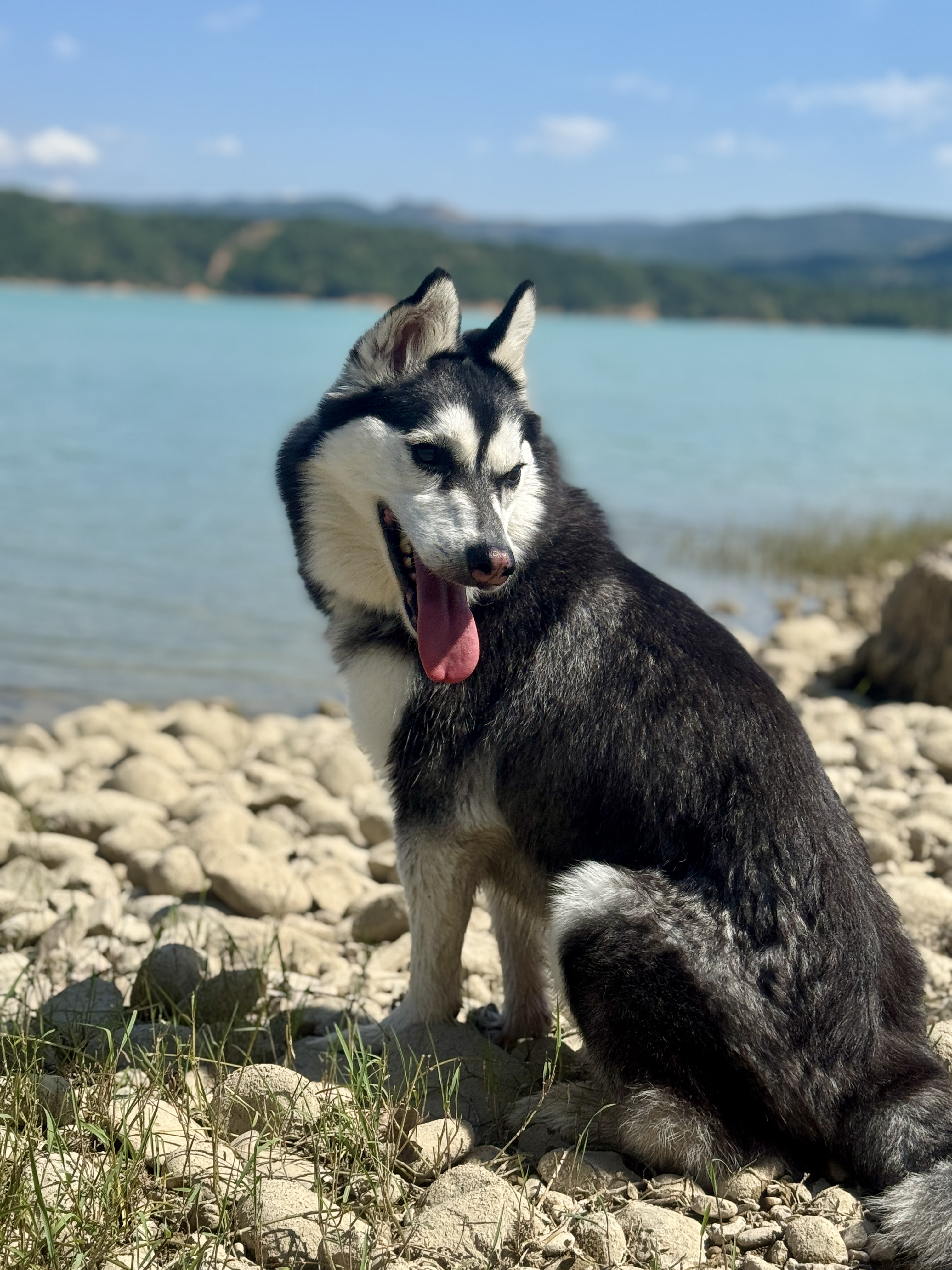
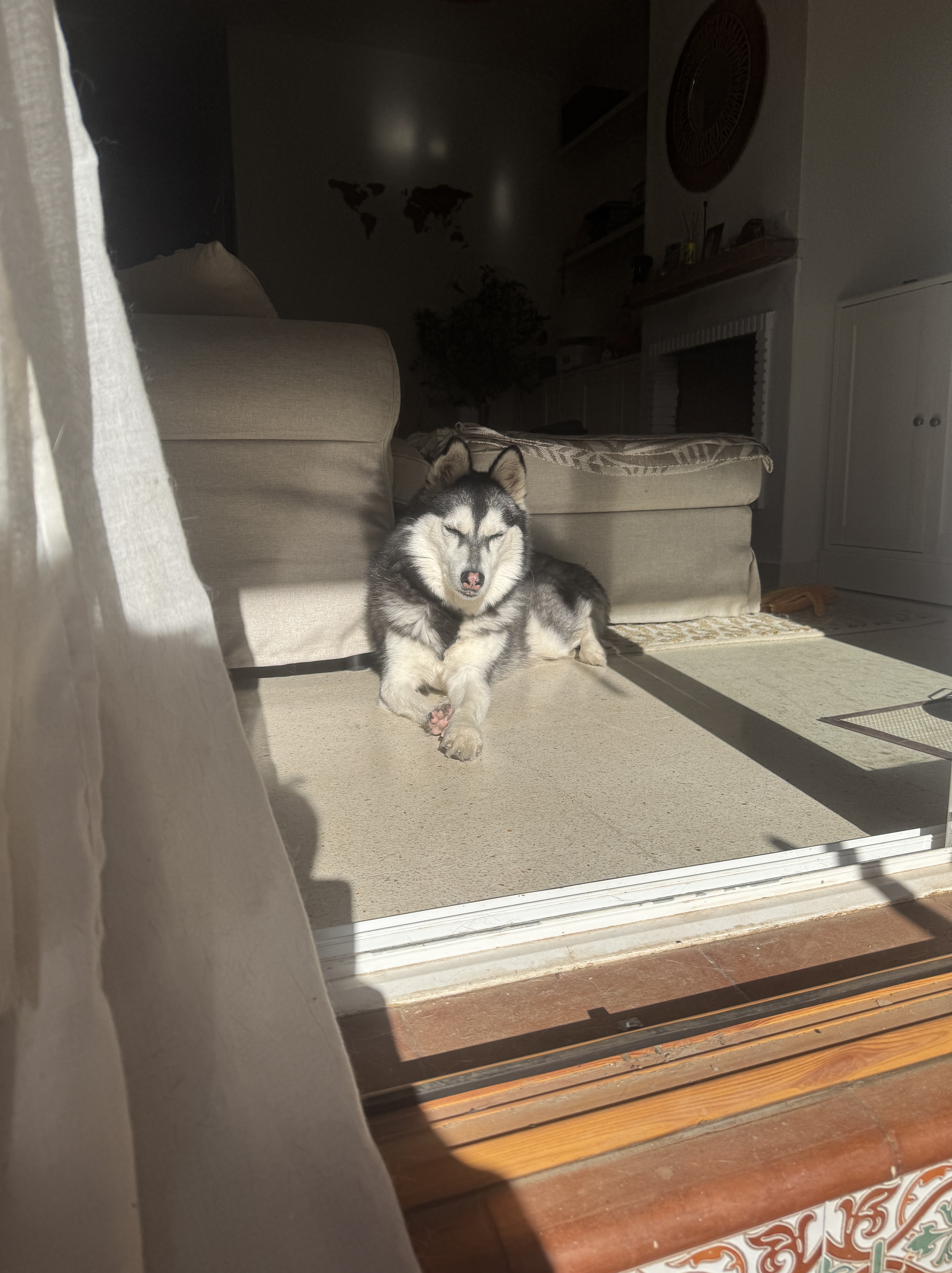
If I’m being honest, when I first met Daisy, partying with friends in Dubai, the last thing I imagined was that three years later we’d be making plans to move our lives—and our Husky Zuko—back into Europe to settle in Alicante, Spain. But as I write this, I find myself sitting in my living room, watching a twenty-year-old episode of Malcolm in the Middle as the smell of freshly cooked pizza drifts from the kitchen, with Daisy sitting next to me crocheting herself a fitting pair of checkered shorts and Zuko curled up sucking on his bed. Yep, you read that correctly. Sucking his bed! And I couldn’t be more content.
In this article
- Preparing Zuko to Move to Spain
- Getting a Dog Used to a Travel Crate
- The Paperwork for Moving a Dog to Spain
- Flying a Dog from the UAE to Spain
- Tracking Our Luggage (and Zuko!)
- Collecting Zuko at the Airport in Spain
- FAQ: Flying with a Dog to Spain
How difficult is it to move a dog to Spain?
Moving a dog to Spain from outside the EU requires vaccinations, a microchip, a health certificate, and import paperwork. With the help of a vet that specialises in pet relocation, the process can be surprisingly straightforward, even when travelling long distances with a dog.
Preparing Zuko to Move to Spain
Ok, so Daisy and I didn’t technically smuggle Zuko from the UAE. If I’m being honest, Zuko draws a reasonable amount of attention. Trying to smuggle a howling three-and-a-half-legged husky from the desert, seven hours to Spain, would be nigh on impossible.
But we did successfully go through the process (legally, I’ll add) of relocating our dog internationally and moving him to Spain. And it was surprisingly easy to do! Once I had been successful in securing a teaching position here in Alicante, Daisy and I had to go through the process of ordering a dog crate, getting Zuko’s immunisations, and paying for the export and import fees.
This sounds like a lot, but we were very fortunate that Zuko was registered with a vet practice that handled much of the paperwork on our behalf, including organising the exportation and importation permits needed from the UAE and Spanish governments. So while the process of moving a dog internationally sounds painful, the organisation was actually very easy and noticeably pain-free. I can’t guarantee that you’ll experience the same thing, but I would recommend doing your research and finding a practice that will support this process.
If you are planning on relocating a pet to Spain, it’s worth checking the latest import requirements through official government guidance before travelling.
Getting a Dog Used to a Travel Crate
With the paperwork being handled by the vets, our next big ‘worry’ was encouraging Zuko—who is already a timid dog—into using his crate. For context, Zuko has always had a ‘thing’ with boxes, bins, and random stuff. So we had our work cut out for us.
Knowing that trying to coax Zuko into his new crate could be a challenging pursuit, we decided to leave this new scary crate in the corner of the room near his bed for him to acclimatise himself to it. Before too long, we upped the ante and started using small treats and toys to encourage him inside. Surprisingly, this worked fantastically well, and before we knew it, Zuko was ‘happily’ (as happily as he could be) using his new crate.
Phew!
For anyone planning on flying with a dog internationally, getting them comfortable with their travel crate early is probably the most important step. Another top tip – avoid putting food in their crate, they rarely eat on flights and are more likely to get messy!
The Paperwork for Moving a Dog to Spain
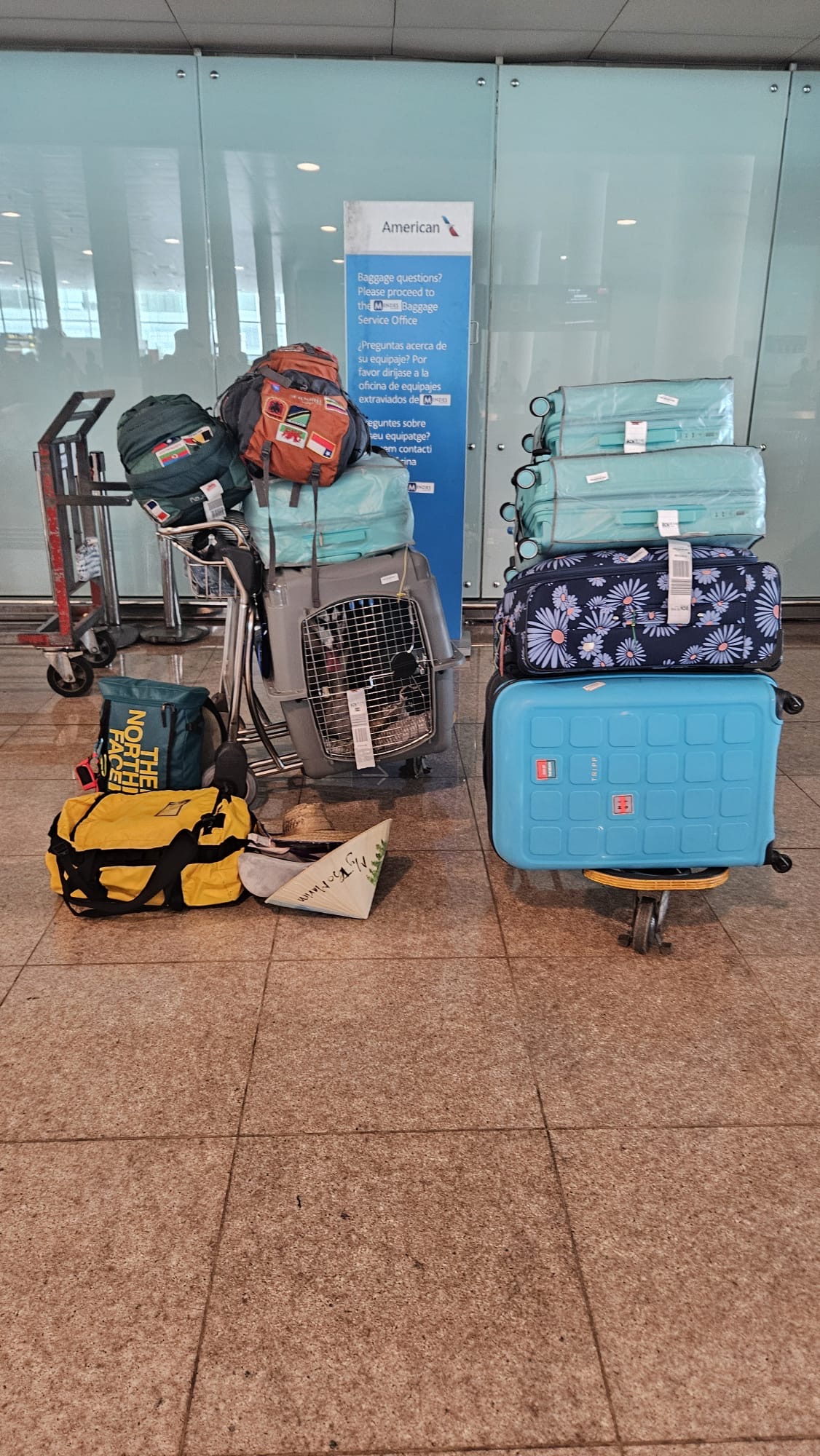
With papers signed, payments made, and several challenging veterinary visits to get Zuko’s immunisations (no vets were harmed in this process, but there were some close finger calls!), it was time to make the big move. Daisy and I had spent several weeks selling much of our belongings and trying to pack our lives into nine suitcases, with the most precious cargo—my golf clubs (and Zuko)—packed safely in their case and crate. Making our way to the airport from Al Ain went smoothly. We just about managed to Tetris our belongings into the back of the large taxi and, before we knew it, we had arrived at Abu Dhabi airport.
Flying a Dog from the UAE to Spain
As with all air travel, there is always a certain amount of anxiety getting to the airport and passing through security. Will our bags be the right weight, or will we be charged extra? Bear in mind we had nine suitcases, so this was especially worrying.
Will my passport scan correctly?
Will I be stopped and searched?
Will everything go smoothly?
The list goes on.
Now add a disabled rescue husky to the mix, and the anxiety was slightly higher than normal. I can say now that these feelings were wasted.
From the moment we walked through the airport front doors to leaving Zuko with the other travelling pups, the process was incredibly smooth. We wheeled him in his crate to the baggage drop, the gentleman behind the desk made a phone call, and another member of airport staff met us and escorted us to an elevator and down several floors to the ‘pet security’ section. After tempting Zuko out of his crate, pushing the crate through the scanner, and then placing him back into it, we said our final goodbyes before making our own way through human security.
As easy as that.
Tracking Our Luggage (and Zuko!)
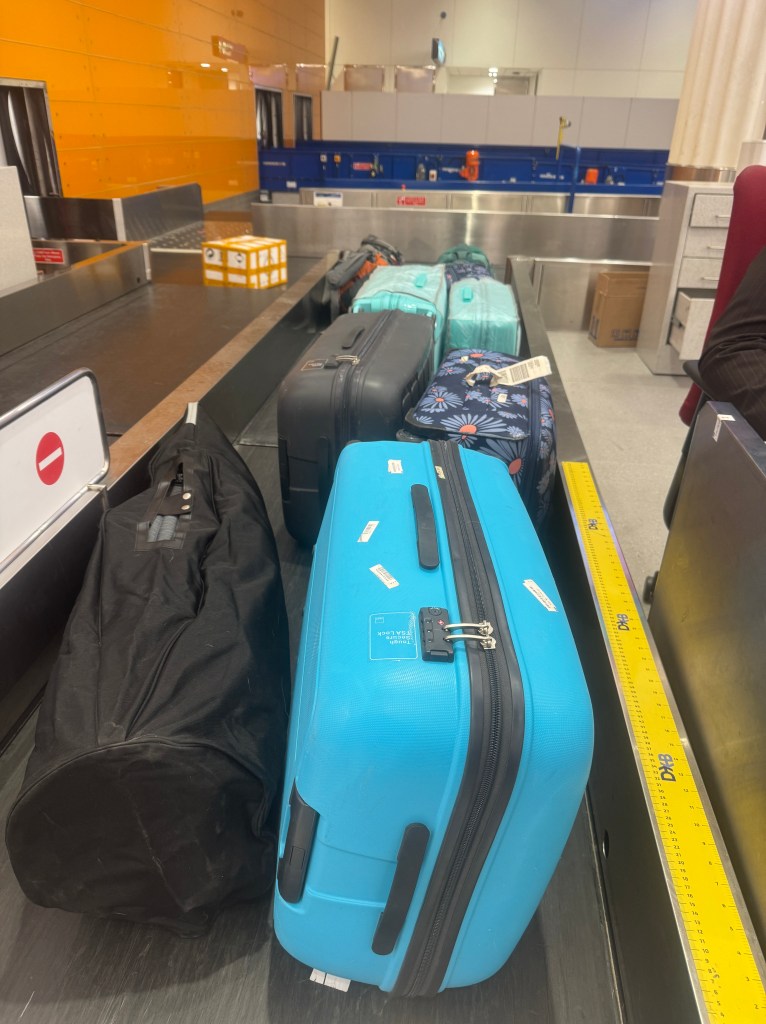
Every time Daisy and I have travelled, I’ve said to myself that I need to buy some travel tracking tags—the type that allow you to track your luggage as you travel. Thinking ahead, I bought several, for the important things. My golf clubs aside, we placed a travel tag in all of our large suitcases and put one in Zuko’s crate.
If you’ve ever wondered where your luggage goes after it disappears on the conveyor belt, it appears to spend much of the time hanging around behind the desks before making its way (probably by truck) to the plane. As for Zuko, he must have had the VIP treatment and made it onto the plane before the rest of the luggage—and before us. Although we hoped to see the fluffy guy being loaded onto the plane, we were at least able to see him virtually.
Collecting Zuko at the Airport in Spain
Fast forward six hours, and several interesting bouts of heart-in-mouth turbulence later, we finally arrived in Spain.
So where was Zuko?
Did he make it across the Med, or was he still waiting on the hot Abu Dhabi runway?
Did he survive the ordeal of the flight?
And let’s be honest—the real question on our minds was whether or not Zuko would survive the flight without being covered in his urine and poo.
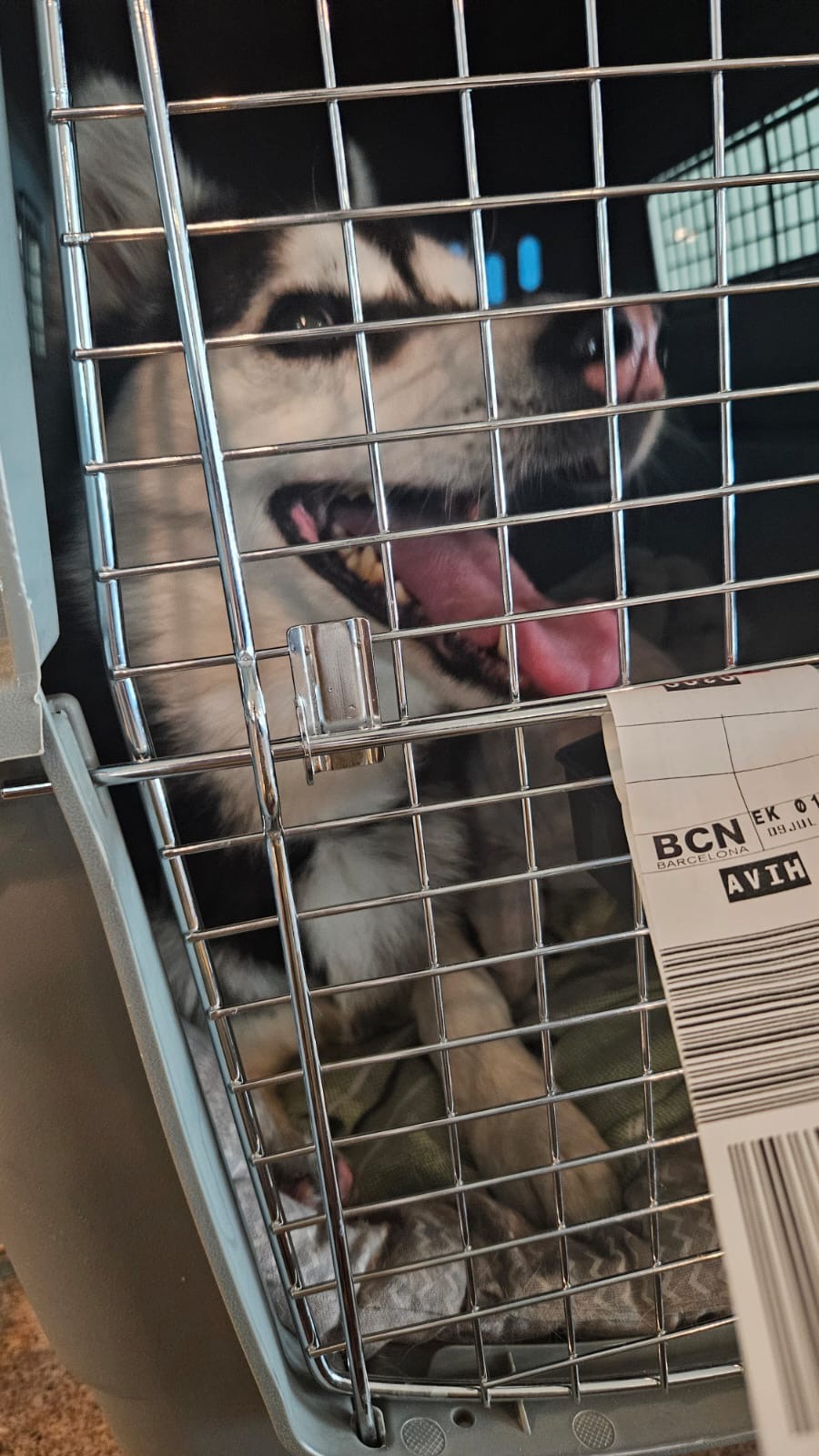
Fortunately, this wasn’t the case. We collected a rather relaxed and docile Zuko from a lovely Spanish lady who was happily pushing him around the luggage collection area, in search of his owners.
“¿Es tu perro?”
Yes.
Yes he is.
Welcome to your new home Zuko.
Vamos!

FAQ: Flying with a Dog to Spain
Is it difficult to fly a dog internationally?
With the right paperwork, vaccinations, and support from a good veterinary practice, flying a dog internationally can actually be far easier than many people expect.
Do dogs fly in cargo on international flights?
Most medium and large dogs travel in a secure, temperature-controlled cargo area designed specifically for animals.
How do you prepare a dog for a long flight?
The most important preparation is crate training, ensuring your dog is comfortable and relaxed inside their travel crate before the flight.
Can you move a dog to Spain from outside the EU?
Yes, but your dog will need the correct vaccinations, microchip, health certificate, and import documentation before entering Spain.
 Active With Alex
Leave a comment